
MBTI Explained: A Research-Informed Guide to Understanding Personality
Full Myers-Briggs Test (MBTI)
Get StartedOrigins, Evolution, and Why MBTI Still Matters
People have long sought reliable ways to decode their motivations, communication preferences, and decision patterns without resorting to vague labels. The MBTI framework grew from Jungian theory and was refined through decades of field application, giving everyday users a structured vocabulary for self-reflection and team dialogue. In modern workplaces and learning environments, it functions as a shared map, helping individuals notice the differences that make collaboration both challenging and rewarding. The result is a language for nuance rather than a box for permanent categorization.
Across professional development programs and coaching sessions, many participants discover an approachable entry point that lowers the barrier to talking about temperament. In that spirit, a well-constructed tool like the Myers-Briggs personality test offers a familiar starting line for those new to personality theory and its practical uses. Instead of forcing people into rigid molds, good facilitators translate preferences into growth strategies, emphasizing flexibility over fixed traits. As people experiment with new tactics for meetings, problem-solving, and feedback, they often notice small but compounding improvements in trust.
The approach gained momentum because it is easy to teach, simple to remember, and supportive of deeper inquiry. In community groups and HR curricula, organizations sometimes circulate materials that reference meyer briggs personality tests while emphasizing that context, culture, and experience shape behavior just as much as innate preferences. Over time, this balance helps teams frame disagreements as differences in information processing or energy flow rather than as personal shortcomings. When used thoughtfully, the framework becomes a catalyst for empathy.
How the Four Preference Pairs Work Together
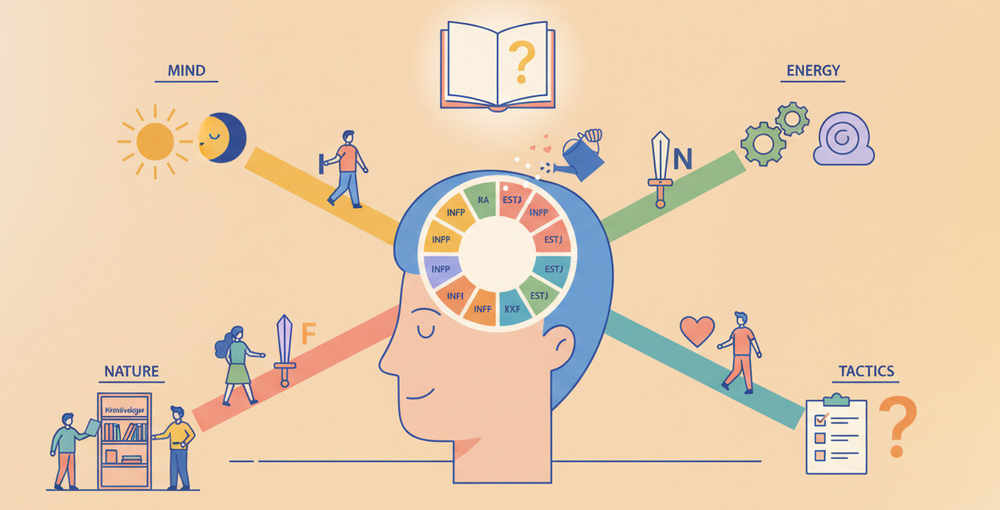
At its core, MBTI highlights four dichotomies: where you focus energy, how you gather information, the way you decide, and the style you use to organize life. When people learn about the spectrum of preferences, they stop treating colleagues as mysteries and start recognizing predictable patterns in communication and planning. In applied settings, trainers often demystify labels by describing patterns across Myers-Briggs personality test types while stressing that preferences describe comfort zones rather than competence limits.
Because jargon can be confusing, it helps to anchor the ideas to everyday behavior and shared goals. When respondents answer a series of carefully designed items, results are organized into an interpretive framework often referred to as the Myers-Briggs personality inventory, which converts self-reported tendencies into an accessible profile. With that profile in hand, people can discuss how they like to brainstorm, which details they consider vital, and how they prefer to close decisions. By exploring interactions between the four pairs, teams can balance speed with reflection.
| Dimension | Preference | Typical Strengths | Watch-outs |
|---|---|---|---|
| Energy Focus | Extraversion / Introversion | Idea generation, connection-building / depth, reflection | Over-talking / under-sharing |
| Information | Sensing / Intuition | Facts, realism / patterns, possibilities | Detail myopia / impractical leaps |
| Decision | Thinking / Feeling | Logic, candor / empathy, harmony | Perceived bluntness / indecision to preserve peace |
| Structure | Judging / Perceiving | Planning, closure / adaptability, openness | Rigidity / procrastination |
Pairings from these four scales create a vocabulary for constructive friction. Teams can use this shared language to decide when to diverge for idea generation and when to converge for decisions. Over time, rituals like agenda sequencing, pre-read distribution, and defined decision windows help translate insights into reliable execution. The result is a workflow that respects both speed and thoroughness.
- Start with strengths to build psychological safety.
- Clarify problem definition before solutioning.
- Rotate facilitation roles to balance preferences.
- Use timeboxing to protect both exploration and closure.
Benefits, Use Cases, and Real-World ROI
Organizations crave frameworks that turn abstract “people issues” into solvable challenges, and MBTI fits that need when applied with care. In hiring, it should never replace qualifications, yet it can enrich onboarding by illuminating communication norms and conflict triggers. In leadership programs, it functions as a mirror that reveals habits under pressure, allowing rising managers to practice alternative scripts for coaching and feedback. High-stakes teams adopt rituals that align with preference diversity, which reduces misfires in handoffs.
When learners want deeper insights and richer interpretation, facilitators may recommend a comprehensive process that resembles a full Myers-Briggs personality test experience paired with coaching. In practice, the most valuable step is the debrief, where participants test-drive new behaviors in realistic scenarios and gather peer feedback. By connecting insights to KPIs such as cycle time, meeting effectiveness, and customer satisfaction, program owners can justify continued investment.
In cross-functional squads, the most frequent payoff is fewer avoidable misunderstandings and more predictable delivery. For legacy teams, leaders often supplement skill training with a structured lab built around a briggs meyer personality test, not as a gatekeeper, but as a shared spark for conversation about collaboration patterns. The point is never to pigeonhole people; the aim is to build a repertoire of responses so individuals can adapt under changing conditions without losing their authenticity.
- Faster conflict resolution through shared language.
- Sharper meeting design that matches team preferences.
- Improved stakeholder management via tailored messaging.
- Stronger coaching habits and peer accountability.
Taking MBTI Thoughtfully and Interpreting Results
Anyone considering an assessment should look for clarity about purpose, context, and follow-up support. Quick, zero-friction tools can spark curiosity, but they should be paired with reflection so results become actionable. For initial exploration, some users try a brief activity similar to a Myers-Briggs personality quiz to learn the vocabulary and consider how preferences show up at work and at home. After that, a guided debrief can transform insights into concrete experiments.
Self-awareness grows when people compare their default tendencies with the demands of their roles. That is why facilitators often weave in prompts that resemble a Myers-Briggs personality self assessment, asking participants to recall high-stress situations and note what changed. By contrasting comfortable behaviors with adaptive behaviors, individuals discover which moments call for deliberate shifts, like slowing down decisions or expanding stakeholder input.
Time-pressed professionals sometimes want a snapshot before committing to a deeper dive. For those cases, a short screener akin to a Myers-Briggs personality test quick resource can provide a launchpad for discussion without overburdening calendars. The crucial step is to treat any snapshot as provisional and refine it through real-world observation, journaling, and peer feedback. With that cycle in place, insights turn into upgraded habits.
- Capture patterns from recent projects in a reflection log.
- Ask teammates how your style helps and where it hinders.
- Pilot one new behavior per week and measure outcomes.
- Revisit insights quarterly to avoid stagnation.
FAQ: Clear Answers to Common Questions
Is MBTI scientifically valid and useful for development?
Research on reliability and validity is mixed, yet practitioners find it helpful when used to spark dialogue rather than to label people. For budget-conscious learners, options that mirror a free Myers-Briggs personality assessment can introduce the core ideas before investing in facilitated debriefs. The best results come from combining assessment insights with coaching, feedback, and ongoing practice in real scenarios.
What’s the difference between a short quiz and a full assessment?
Short instruments are designed to teach vocabulary and highlight likely preferences, while comprehensive processes include richer interpretation and guided application. If you only need an orientation to type language, a concise activity like a Myers-Briggs personality type quiz can be enough to get started. For role-specific development or leadership transitions, a deeper process usually pays off.
Can MBTI help with team conflict and communication?
Yes, especially when the team builds rituals that respect diverse preferences for information, decision speed, and structure. After a shared learning experience, teams can map recurring tensions and agree on norms that turn friction into constructive debate. Leaders who model curiosity and flexibility make it safer to experiment with new collaboration patterns.
Where can I learn more without large upfront costs?
Many organizations publish primers, webinars, and guided activities that explain the four dichotomies and common patterns. To explore the framework at your own pace, some learners start with resources similar to a free Myers-Briggs personality inventory and then add peer discussion to ground the concepts in daily work. Over time, the most valuable insights come from observing how preferences play out under pressure.
Should MBTI be used for hiring decisions?
No, hiring should be based on role requirements, demonstrable skills, and evidence of performance, not on type preferences. MBTI shines as a development tool that supports communication, coaching, and team design. When used ethically, it complements, not replaces, competency models and structured interviews.